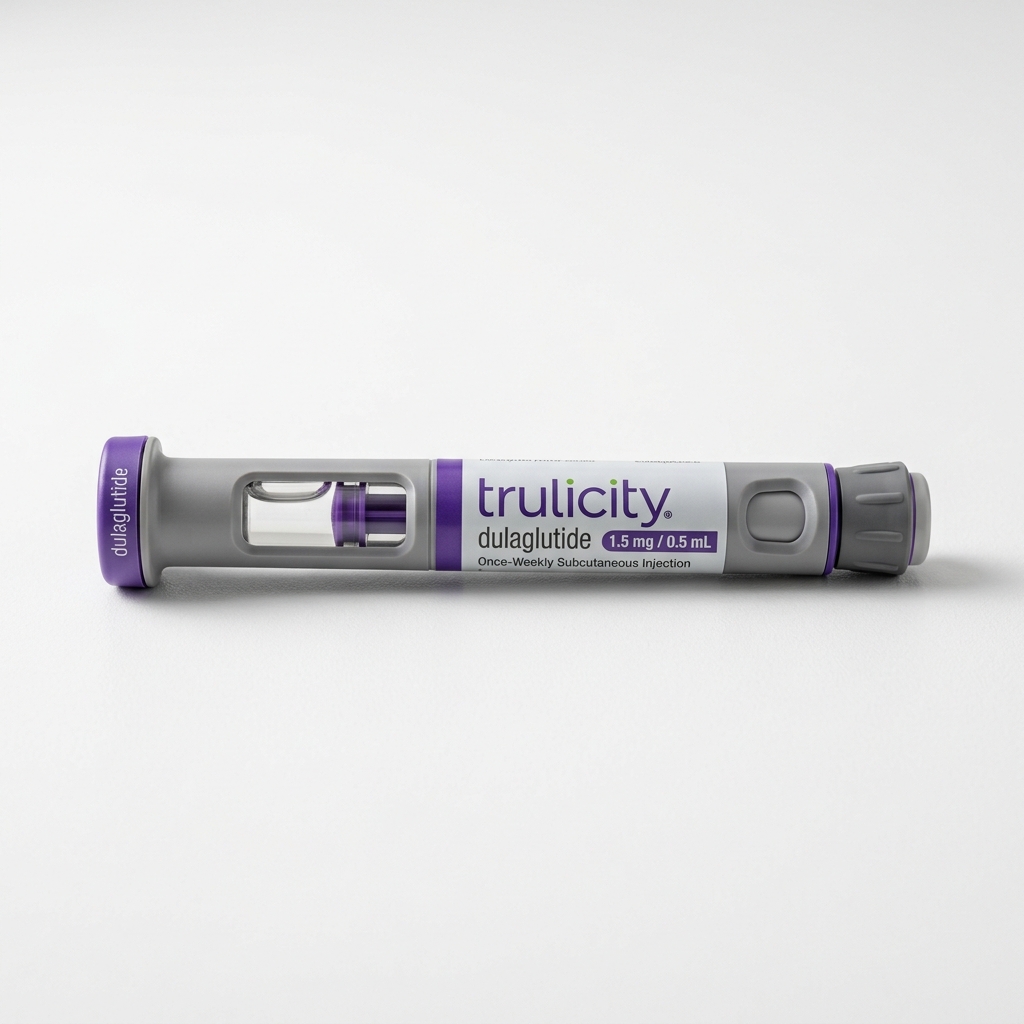
Trulicity®
Subcutaneous injection (pre-filled pen). GLP-1 Receptor Agonist.
Medically reviewed by Dr. Sarah Chen, PharmD • Last updated April 2026
FDA Status
Approved
Manufacturer
Eli Lilly
Generic Name
dulaglutide
Typical Cost
$900/mo
Delivery Method
Subcutaneous injection (pre-filled pen)
What is Trulicity?
Trulicity is a GLP-1 receptor agonist medication manufactured by Eli Lilly, FDA-approved in 2014 for blood sugar management in adults with Type 2 diabetes. Its active ingredient, dulaglutide, works by mimicking the GLP-1 hormone to stimulate insulin secretion, inhibit glucagon release, and slow gastric emptying — improving blood sugar control while producing modest appetite suppression. In clinical trials (AWARD program), patients taking Trulicity achieved A1C reductions of 0.7–1.6% and typically lost 3–5% of body weight as a secondary benefit. Trulicity is administered as a once-weekly subcutaneous injection using an easy-to-use pre-filled pen with a hidden needle and automatic injection mechanism, making it one of the most patient-friendly injection devices available. As of April 2026, Trulicity costs approximately $900 per month at retail pharmacies without insurance, though Eli Lilly’s savings programs and insurance coverage can significantly reduce out-of-pocket costs. Compared to newer GLP-1 agents like Mounjaro, Trulicity produces considerably less weight loss due to its single-receptor mechanism.
Overview
Weekly injection approved for Type 2 diabetes. Less commonly used for weight loss compared to semaglutide and tirzepatide, but still prescribed for patients who need both diabetes and weight management.
Pricing
Typical retail pricing for Trulicity is approximately $900/mo without insurance. Compounded alternatives may be available at lower cost through telehealth providers.
How It Works
Trulicity (dulaglutide) works as a GLP-1 Receptor Agonist. It mimics natural hormones that regulate appetite, blood sugar, and satiety signals.
Common Side Effects
- Nausea (typically worst during dose escalation)
- Diarrhea and constipation
- Headache and fatigue
- Reduced appetite (the intended therapeutic effect)
How It Compares
Trulicity (dulaglutide) is a once-weekly GLP-1 injection for Type 2 diabetes. Its primary competitor within the diabetes category is Ozempic (semaglutide), which has significantly more weight-loss data and broader off-label use.
For patients whose diabetes management would also benefit from meaningful weight loss, Mounjaro (tirzepatide, dual GLP-1/GIP) consistently outperforms single GLP-1 agonists in trials. See Ozempic vs Mounjaro for a comparison of the leading diabetes GLP-1s.
For the broader semaglutide vs tirzepatide class question, see the full comparison.
Frequently Asked Questions
How much does Trulicity cost per month?
Without insurance, Trulicity costs approximately $900 per month at retail pharmacies as of April 2026. With commercial insurance and the Eli Lilly savings card, copays can be reduced to $25–50 per month for eligible patients — making it accessible for commercially insured patients with a Type 2 diabetes diagnosis. At $900/month retail, Trulicity is moderately priced compared to other GLP-1s, but the efficacy-to-cost ratio is relatively poor compared to newer alternatives. Mounjaro (tirzepatide, also from Eli Lilly) costs $1,023/month at retail but produces 20.9% weight loss versus Trulicity’s 3–5%; the additional cost buys substantially more therapeutic benefit. The $25 savings card available for Mounjaro is comparable in savings to Trulicity’s card. If you’re currently on Trulicity and have not achieved your diabetes or weight-loss goals, ask your provider whether Mounjaro or another newer agent would offer better outcomes. For most patients, Trulicity is not the recommended starting point for new GLP-1 prescriptions in 2026.
Is Trulicity good for weight loss?
Trulicity is FDA-approved for Type 2 diabetes, not weight loss, and its weight-loss results reflect that limited optimization. In the AWARD clinical trial program, patients on Trulicity typically lost 3–5% average body weight over the course of treatment — a modest benefit compared to the dramatic improvements seen with newer GLP-1 agents. For context: Wegovy (semaglutide) achieved 14.9% mean weight loss in STEP-1, and Zepbound (tirzepatide, from the same manufacturer as Trulicity) achieved 20.9% in SURMOUNT-1. The gap between Trulicity and these newer options is clinically significant. For most patients with obesity or overweight who want meaningful weight loss, Trulicity is not an appropriate first choice. Mounjaro or Zepbound (both from Eli Lilly, containing tirzepatide) produce far more weight loss at a comparable or only slightly higher cost. The only scenario where Trulicity makes sense for weight management is when newer alternatives are contraindicated, unavailable, or not covered by insurance.
What’s the difference between Trulicity and Ozempic?
Both Trulicity and Ozempic are once-weekly injectable GLP-1 receptor agonists FDA-approved for Type 2 diabetes, but they contain different active ingredients — dulaglutide and semaglutide, respectively — with different clinical profiles. Ozempic (semaglutide) consistently produces stronger A1C reduction and significantly greater weight loss at its higher doses: the 2 mg dose achieved 14.9% weight loss in the SUSTAIN trials, compared to Trulicity’s 3–5%. Trulicity has been on the market since 2014 and has its own cardiovascular outcomes data from the REWIND trial, which showed reduction in major adverse cardiovascular events in patients with established or at-risk cardiovascular disease. Ozempic also has cardiovascular outcomes data through the SUSTAIN-6 trial. For new Type 2 diabetes prescriptions in 2026, most providers now prefer Ozempic or Mounjaro based on superior clinical data. Trulicity remains on formularies for patients who are stable and tolerating it well, but it’s infrequently initiated as a first-choice agent for newly treated patients.
Should I switch from Trulicity to Mounjaro or Ozempic?
If your Type 2 diabetes is well-controlled on Trulicity — A1C at goal, side effects manageable, and copay affordable — there may be no urgent clinical reason to switch. The “if it ain’t broke” principle applies. Trulicity has a well-established safety record from the AWARD trial program and years of real-world use since 2014. However, if you’re not at A1C goal, want meaningfully more weight loss, or your diabetes management could be optimized, both Mounjaro and Ozempic have superior clinical data. In the SURPASS-2 trial, tirzepatide (Mounjaro) outperformed semaglutide (Ozempic) directly in head-to-head data for both A1C reduction and weight loss. Insurance coverage and formulary position often drive these decisions in practice — some plans have preferred Trulicity tiers that make switching less attractive financially. Discuss with your provider and review your plan’s current formulary before initiating a change.
How do I inject Trulicity?
Trulicity uses a pre-filled, single-use AutoInjector pen that makes the injection process relatively simple, even for patients new to self-injection. Remove the pen from the refrigerator 30 minutes before use to allow it to reach room temperature — cold injections are more uncomfortable. Place the pen against the skin of your abdomen, thigh, or upper arm, click the button, and hold it in place for 5–10 seconds until the injection indicator confirms completion. The pen features a hidden needle and an automatic injection mechanism, so you never see the needle — a meaningful benefit for needle-averse patients. Rotate injection sites each week — for example, alternating between abdomen left, abdomen right, and thigh — to reduce irritation and improve absorption consistency. Inject on the same day each week (or within a 3-day window if you need to adjust timing). The used pen is a single-use device that should be disposed of in a sharps container. Store unused pens in the refrigerator; do not freeze. If room temperature storage is needed for travel, pens can be kept at room temperature for up to 14 days.