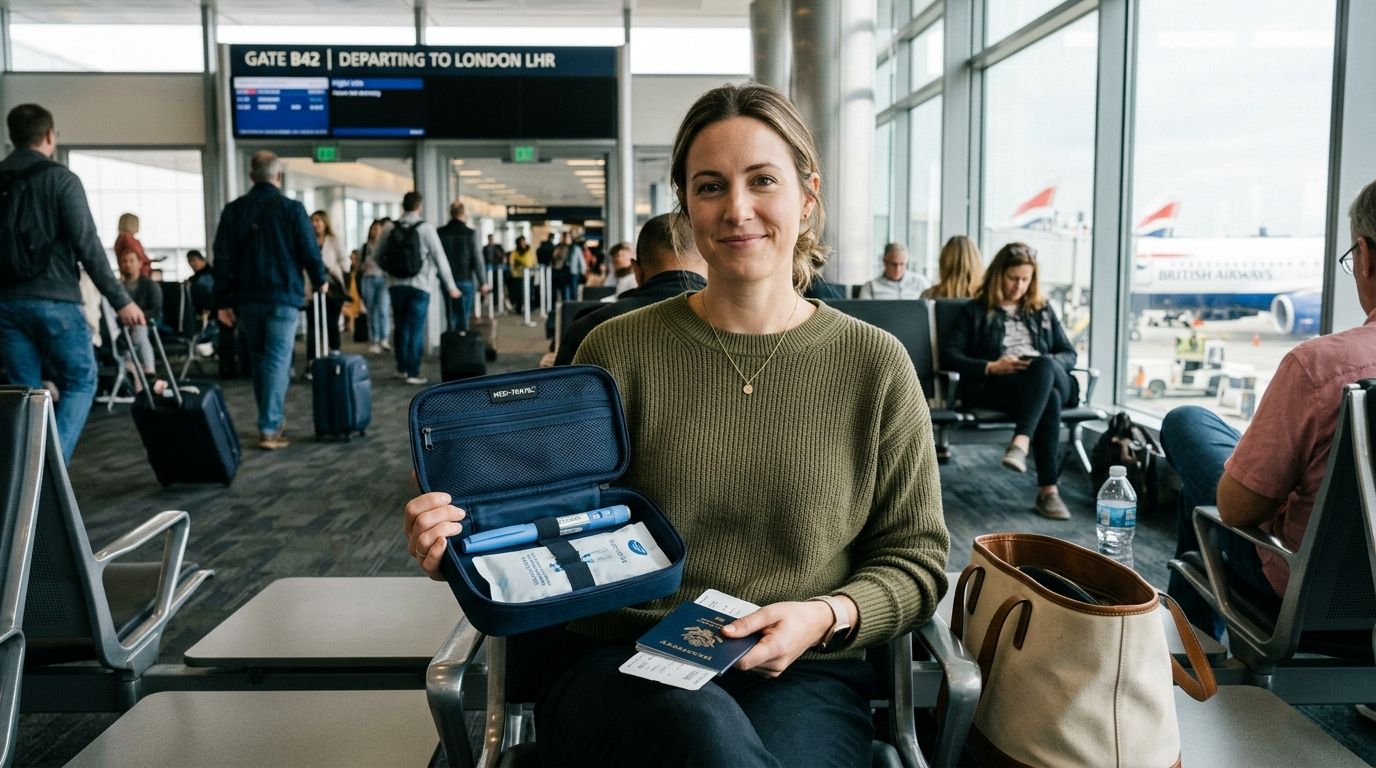
How to Travel With GLP-1 Medications
Traveling with injectable medications raises legitimate questions: Can you bring needles through security? Do you need a doctor’s note? What about temperature requirements? Here’s the complete guide.
TSA Rules (Domestic US)
The Transportation Security Administration explicitly permits injectable medications in carry-on bags. Here are the rules:
What’s allowed in your carry-on:
- Pre-filled pens (Ozempic, Wegovy, Mounjaro, Zepbound)
- Needles and syringes
- Alcohol swabs and sharps containers
- Ice packs, freezer packs, and gel packs for temperature control (even if frozen)
- Liquid medications are exempt from the 3.4oz/100ml limit
What TSA recommends (but doesn’t require):
- Keep medications in original packaging with the pharmacy label
- Carry a copy of your prescription or a letter from your doctor
- Declare your medications to the TSA officer at the checkpoint
- Request a visual inspection instead of X-ray if concerned about medication integrity
In practice: Most TSA agents see injectable pens regularly and won’t blink. But having the pharmacy label visible speeds things up if questions arise.
Cold Storage During Travel
Which GLP-1s Need Refrigeration?
| Medication | Unopened | In Use (opened) |
|---|---|---|
| Ozempic pen | Refrigerate (36-46°F) | Room temp up to 56 days |
| Wegovy pen | Refrigerate (36-46°F) | Room temp up to 28 days |
| Wegovy pill | Room temp | Room temp |
| Mounjaro pen | Refrigerate (36-46°F) | Room temp up to 21 days |
| Zepbound pen | Refrigerate (36-46°F) | Room temp up to 21 days |
Key insight: If you’re using an opened pen, you likely don’t need cold storage for trips under 3 weeks. The pen is fine at room temperature (up to 86°F / 30°C).
For unopened pens or longer trips:
- Use an insulated medication travel case (Frio, MedAngel, or similar — $15-40)
- Hotel mini-fridges work for overnight storage
- Ask your hotel front desk to store medication in their kitchen fridge if your room doesn’t have one
- Never put injectable pens in checked luggage (cargo holds can freeze, which destroys the medication)
- Never leave pens in a hot car
2026 update: Wegovy recently dropped its cold chain requirement in the EU, meaning room temperature storage and shipping is now allowed there. The US hasn’t followed yet, but this signals the direction.
International Travel
Crossing Borders With Injectable Medications
Different countries have different rules, but the general approach is the same:
Always carry:
- Original pharmacy-labeled packaging
- A letter from your prescribing doctor (on letterhead, stating your name, the medication, the dose, and that it’s medically necessary)
- A copy of your prescription
- Enough medication for your trip plus a few extra doses (in case of delays)
Country-specific notes:
Canada, UK, EU, Australia, Japan: Generally straightforward. Prescription medications for personal use are allowed with documentation. Quantities should be reasonable (90-day supply max is a safe rule).
Mexico: Prescription medications for personal use are permitted. You’re allowed to bring a reasonable supply (generally up to 90 days). Having documentation helps at customs.
Middle East / Asia: Some countries have stricter import rules on medications. Check the embassy or consulate website for your destination before traveling. Injectable medications sometimes require additional permits.
Universal tip: Always carry medications in your carry-on bag, never in checked luggage. If your bag is lost, you can’t miss doses.
Timing Your Doses Around Travel
Crossing Time Zones
Semaglutide and tirzepatide are weekly injections. A few hours’ variation doesn’t matter.
Rule of thumb: Take your injection at your normal time in your HOME time zone. If you normally inject at 8 PM Eastern and you’re in London (5 hours ahead), inject at 1 AM London time — or just do it before bed. A 6-12 hour shift in timing once won’t affect efficacy.
If you’re traveling for more than a week: Gradually shift your injection day to align with your destination time zone. Your body won’t notice a half-day shift.
What If You Miss a Dose While Traveling?
- Less than 5 days late (semaglutide) / less than 4 days late (tirzepatide): Take it as soon as you remember, then return to your regular schedule.
- More than 5 days late: Take your dose as soon as possible, then adjust your regular day to the new day.
- Don’t double up. If you missed a dose, just take one dose.
Packing Checklist
- Medication pens (enough for trip + 1-2 extra doses)
- Pen needles (extra — these are small and easy to lose)
- Alcohol swabs
- Insulated travel case (if carrying unopened pens)
- Doctor’s letter (international travel)
- Prescription copy
- Small sharps container (or use a hard plastic bottle like an empty water bottle)
- Oral Wegovy/Rybelsus (if applicable — no cold storage needed)
The Bottom Line
Traveling with GLP-1 medications is much simpler than it sounds. TSA allows everything, most countries accept personal prescription medications with documentation, and if your pen is already opened, you likely don’t even need cold storage. Keep it in your carry-on, have your documentation ready, and inject on your normal schedule.
This article is for informational purposes only and does not constitute medical advice. Check specific country regulations before international travel with any medication.